
Mother 3 - Theme Of Love
26/01/26

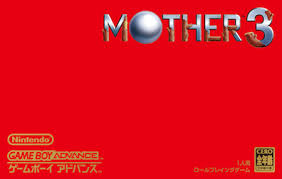
If I had ever had a single goal writing for the Game Boy Abyss, it was to hit one hundred reviews. From the very start, there was never any doubt as to what my hundredth game would be; what else could it be, then what I consider the greatest game released on the handheld. What could it be, other than one of my favourite games I’ve ever played? What else could it possibly, ever be, then the game that speaks to me on the deepest, more primal level, that makes me cry effortlessly, that fills me with hope at the drop of the hat? There was never any doubt that my hundredth game I would review for this website would be Mother 3, the third and likely final entry in the Mother/Earthbound franchise. Strap in - this is the longest, most rambly, probably-not-so-good complex review I’ve ever written - and it’s filled with nothing but my passion for one of the greatest games ever made.
As a disclaimer, I will be talking about mild spoilers throughout, and also be talking about a major plot element that’s no further than one hour into the game. Normally I’d avoid that, but it’s more or less the incident that kicks everything off, and it’s personal impact to me is incredibly important to what I want to convey in this review. Also, there’s a certain group of people in this game - the Magypsys - whose name reeeeally hasn’t aged well in the last few decades, but it’s the official name, so just be aware.
What Almost Wasn't
Mother 3 probably ranks amongst the most famous - or infamous - games to never see a release in the West; due to the DS already being a few years old at it’s release, it’s niche subject matter and the fact Earthbound’s western release was very all contributed to the game never releasing in the west, leading to a fantastic fan patch which is the sole - and arguably best - way to play the game. The game’s development was as convoluted as its lack of release; after a cancelled production for the Nintendo 64, the game was finally developed and released at the tail end of the handheld’s lifespan and, as far as I can tell, the final first-party game for the GBA. In many ways, Mother 3 feels like the end of an era for the era of turn-based RPGs; whilst, of course, they would continue to exist, the number of pixel-styled, SNES-esque RPGs made in the vein of Earthbound and everything surrounding it that Mother 3 conveys rapidly fell in the late 2000s.
Mother 3 follows the foundations set by Mother and Earthound, but whilst I haven’t finished either of them, I feel it leans structurally towards the first game then the second. Earthbound’s facade is that of a satire of JRPGs, whilst Mother 3 feels more traditional in its foundation. You’ll play as a variety of colourful characters, wander bespoke, beautiful locations and engage in RPG battles. The facade of Mother 3 structure isn’t anything special - it’s simply a slightly more linear, heavy story-based JRPG that looks and sounds stunning. But the devil is in the details. Pretty much every structural element of Mother 3 goes above and beyond in creating something that adheres to what came before, but feeling unlike anything in its contemporary space. It’s a game that will devour you more and more as you put hours into it - but for myself, it’s the game's inciting, defining incident that drew me in.
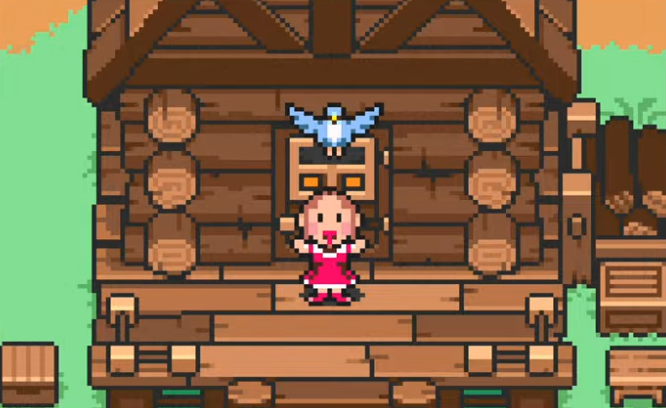
I’m not sure if I’ve mentioned it before on this specific website, but a pretty defining element of my life is that when I was little older than six, my mother passed away. I was young enough to be upset, but not really totally understand the impact it would have on my life, and as the years have passed, that impact has grown. So, coupled with the fact that my feelings on Mother 3 transcend anything else I’ve played so far, we’re doing things a little bit different. Let’s talk about Mother 3’s opening hours in a little more detail.
Myself and Lucas - A Tale of Two Mothers
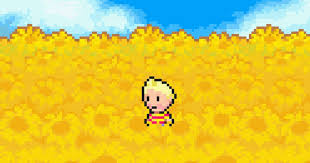
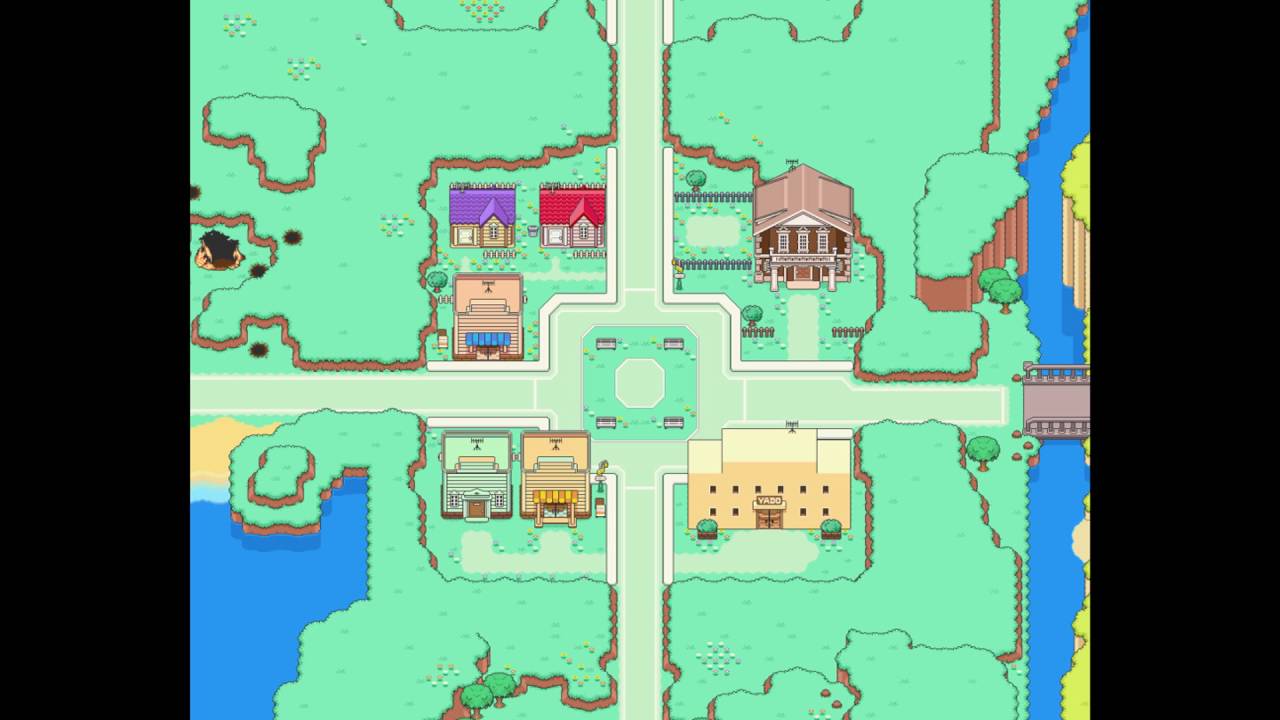
The setting of Mother 3, the Nowhere Isles, is a place where nature and humanity peacefully co-exist; people share, not sell, neighbor helps neighbor, and even the fantastical creatures live in harmony with the smallest of children. This is chiefly seen in the game’s initial sequence, where protagonist Lucas is visiting his grandfather along with his brother, Claus, and his mother, Hinawa. Here, you’re introduced to one of Mother 3’s most iconic creatures: The Dragos. The Dragos are gigantic, dinosaur/dragon-like creatures, more monstrous then many of the enemies you’ll actually be fighting across Mother 3’s world, but it’s quickly shown that they’re some of the sweetest, most playful beasts you’ll ever see. Lucas and Claus, the tiniest children you can imagine, are playfighting with the Dragos, and none can even conceive of them being in any danger. It’s a simple sequence that tells you one fact: the world of Mother 3 is as peaceful as you could hope for, and everything is perfect.
And then, a strange, steel object, so different to everything in the Nowhere Isles, splits the sky, blaring music that serves as a harbinger of doom.
Later that day, a massive forest fire has broken out in the great forest that borders Lucas’s hometown, Tazmily Village. The perspective shifts to Flint, Lucas’s father, who battles through the flames - and the suddenly appearing violent, chimeric creatures - to rescue fellow villagers. But when the flames die out, a realization falls across the village - Lucas, Claus, and Hinawa are still missing, having been travelling via the forest on the return journey from the boy’s grandfather’s house. Flint travels through the charred forest, still encountering the crazed wildlife and chimera-like beings until he learns that up ahead, his family has been found. Flint makes haste, and finds his shivering - but safe - children huddled around a fire. The entire town seems to be here, but as Flint looks around for his wife, the town blacksmith steps forward, urging Flint to be calm. Uneasily, he describes a Drago fang he’d found during the search, babbling about how it could make an incredible weapon.
Before revealing that he’d found it lanced through Hinawa’s heart.
It’s a moment that you feel is inevitable as you make your way, desperately, through the forest. Hoping against hope that Flint’s family is safe, not wanting to listen to the part of your brain that knows how writing works, knows the only way this can end. And this is how it happens - Hinawa is dead, and even after playing through this sequence multiple times, the reveal is never less devastating.
What follows is one of the darkest, most emotionally primal moments I’ve ever seen in a Nintendo game. Wordlessly, Flint falls apart. He beats the grounds in a rage, takes a log from the burning fire and slams it upon the ground. The villagers, horrified, beg Flint to calm down, lest he further traumatize his children, but he doesn’t relent, physically assaulting villagers who attempt to calm him, ultimately culminating in Flint being knocked unconscious and thrown into prison to cool off.
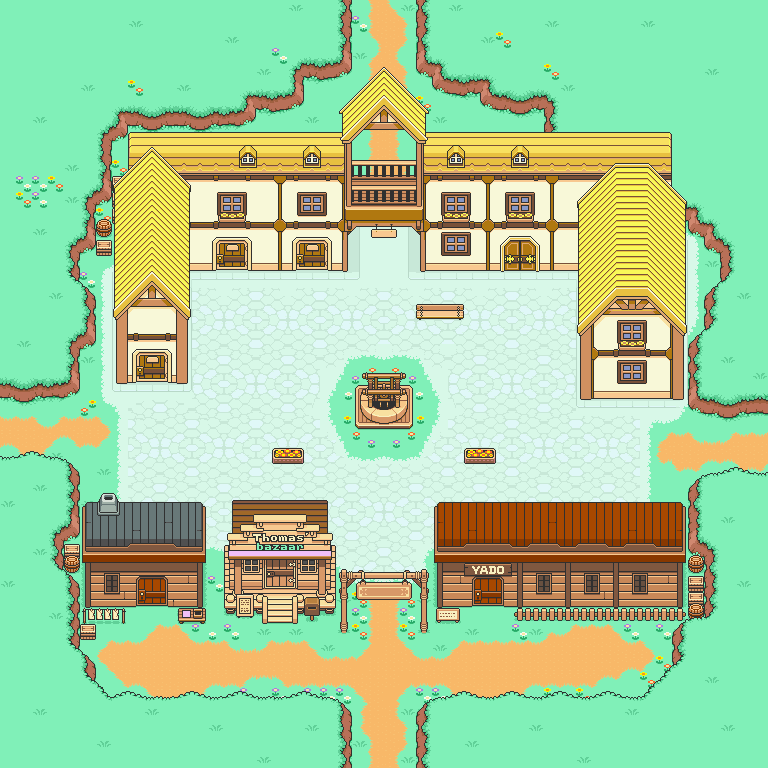
From there, it feels as if the world loses its cohesion. Claus goes missing, and Flint leaves on daily journeys into the mountains to search for his lost son, essentially abandoning Lucas to fend for himself. The Pig Mask Army, a force of soldiers who’ve created the chimeras and attempt to establish a capitalistic society upon the Nowhere Isles, begins to infect everything they touch with their twisted ideology. Years pass as the game progresses, and the very moral and physical fabric of the sleepy Tazmily Village begins to change as modern conveniences - currency, electricity, television - begins to infect its pastoral roots. The world is tainted by the fruit of progress.
But despite the wild, world-shattering twists the story takes, I can’t help but focus on where it all started - Hinawa’s death, and the way it seems everything stems from that very moment.
By all accounts, my mother was a pillar of my community too. She was a woman loved by all, who volunteered frequently at my school, and loved my family even more. I even remember, in those days that feel so long ago now, bonding over my blooming love of video games, playing Yoshi Story, Diddy Kong Racing, and Mario Kart together - she even got me for Christmas the very first game that was -mine-. Super Mario 64, a game that I hold as probably the most important game that I ever played. All this to say… seeing how Hinawa’s death affects not only her husband, her children, but her community and the world at large… It’s not the same, but through Lucas and Flint and everyone in this world… I see more than a little bit of myself. It makes certain moments of Mother 3 fill me with emotion that I just didn’t feel in the decade since I last played it.
Hinawa’s death feels like it affects everything in the Nowhere Isles… but just like me, a mother’s death will have no great effect then on the child, or children, she leaves behind. Mother has never been a more apt name for this series than now.
The Rotten Fruit of Progress
I don’t think it’s a stretch to say that Mother 3 ranks amongst the most mature stories Nintendo have ever produced. The arrival of the Pigmask Army, not to mention their nationalistic themes and militaristic garb, and the way they begin to reshape the societies of the world to their whim feels like a response to any number of fascist dictatorships of the 20th century. Additionally , introducing currency into the community of Tamizily Village, instantly inciting greed, anger, and all that comes with it, alone is a scathing indictment of late-stage capitalism. Whilst I 100% adhere to the concept that all art is political, I don’t think anything Nintendo has produced remotely matches the viewpoint or ferocity that Mother 3 depicts - hell, I don’t think many games today match it.
Above all, as initially showcased in the game’s logo, of natural wood choked and twisted by the ‘steel’ of progress, the way Mother 3 corporate greed, over-consumption and unchecked avarice choke the beauty of nature feels like the game’s ultimate warning for the future - and that the fate of our own world lies with those who grasps the future with two hands, a metaphor that’s given physical form in the shape of the game’s major late-game McGuffin, the Needles. But I’ll leave the story of the Needles for you to discover.
As you’ll quickly learn from the switch between Lucas and Flint in the early moments of the game, Mother 3 features a whole suite of characters you’ll play from the perspective of. Much of the first half of the game seems to dance between genres before settling into a true RPG, more consistent adventure around the fourth chapter of the game, where you finally take control of Lucas for good. It expertly sets the dominoes, drawing your attention with more apparent matters before revealing the truth of everything the game is building towards.
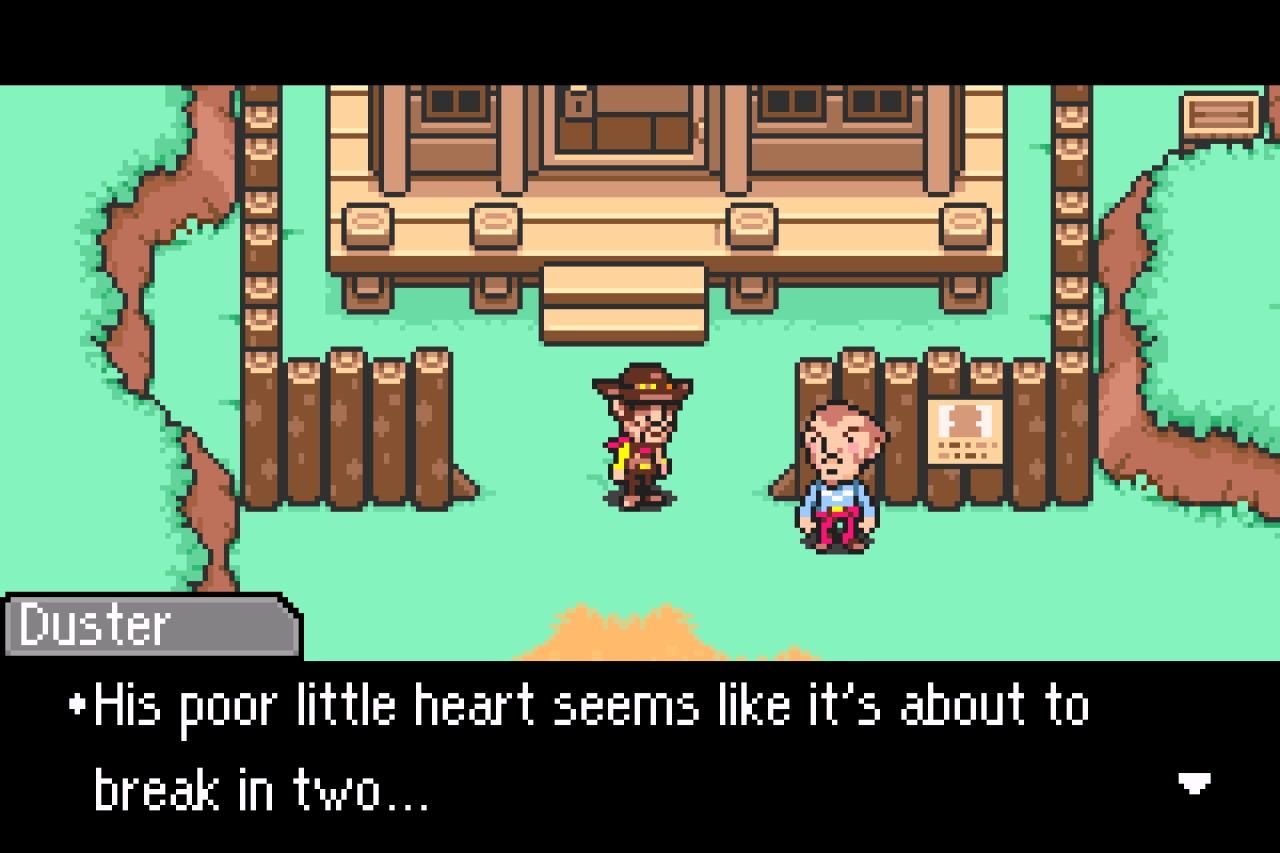
The second chapter, featuring the benevolent, handicapped thief Duster, lays the foundations for the depth of tragedy to come in the form of a spooky caper. In contrast, Chapter 3, where you play as the more-or-less helpless monkey, Salsa, showcases the corrupting initial ‘attack’ of the Pig Mask Army’s capitalist desires and an insight to how they treat animals. You see the corruption born in Tazmily Village, before spreading further and further, until the fate of the world itself - not just humanity, not just the animals, but nature, the world itself, is under threat from the all-consuming machinations of the PigMask Army. Chapter 4 is when the ‘RPG’ that is Mother 3 truly begins, but that’s not to say anything before is just a prelude - it’s all part of the tapestry that is Mother 3. And the rest? Well, if you’ve made it this far in the review, I think you’re willing to give the game a try, so I hope you’ll explore the depth of what this game has to offer.
I wouldn’t dream of spoiling how this amazing game ends, but the last third of the game literally focuses on Lucas, representing the good of humanity, grasping the future of the Nowhere Isles with his own two hands, to guide the world to a happy, natural future. At the same time, the leaders of the Pig Mask Army are trying to do the same, to grasp the future and contort it into its dark perversion already made apparent with their chimera 'experiments’. Overall, it’s a stark reminder to us, the players, to take the future of our natural world into our own hands; we might not have as physical a metaphor as the one Mother 3 depicts, but it’s just as important. The game tells us that if we work towards it, if we stand up to the evils in this world… we’ll get the good future we want. Maybe, just like Mother 3, we’ll have a happy ending.
Maybe it will.
Everyday Weirdness
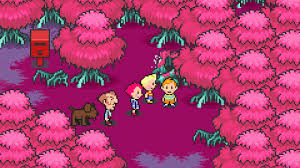
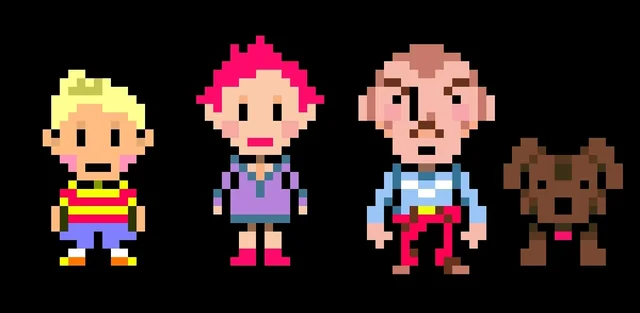
Following in the footsteps of the first two Mother games, the game’s cast very much feel like the ‘Everyman’ answering the call to action, and thus, its core cast is a ‘less is more’ kind of deal. Lucas is a fantastic silent protagonist, as the way the game directs its more emotional moments, like the aforementioned mirror scene or some of its darkest scenes, you can almost hear Lucas’s thoughts without anything. Duster is very much a Local Man who seeks to do good and earn the approval of his father - and, incidentally, has a bum leg, an element that’s cool is just part of him. Kumatora, the princess of the castle that lies nearby Tazmily Village, is the exception to the ‘everyman’ concept, but her role is tied more into some late game reveals that I’ll leave for y’all to discover. Plus, I could never have bad things to say about a game that features the protagonist's dog as a permanent party member. Boney the Dog may very well be the sweetest, loving, silliest dog in all of gaming - his constant bark-translated dialogue never fails to lift the mood, and his first ‘conversation’ with Lucas where he asks “Do you want me to take you for a walk?” makes me laugh and my heart swell in equal measure.
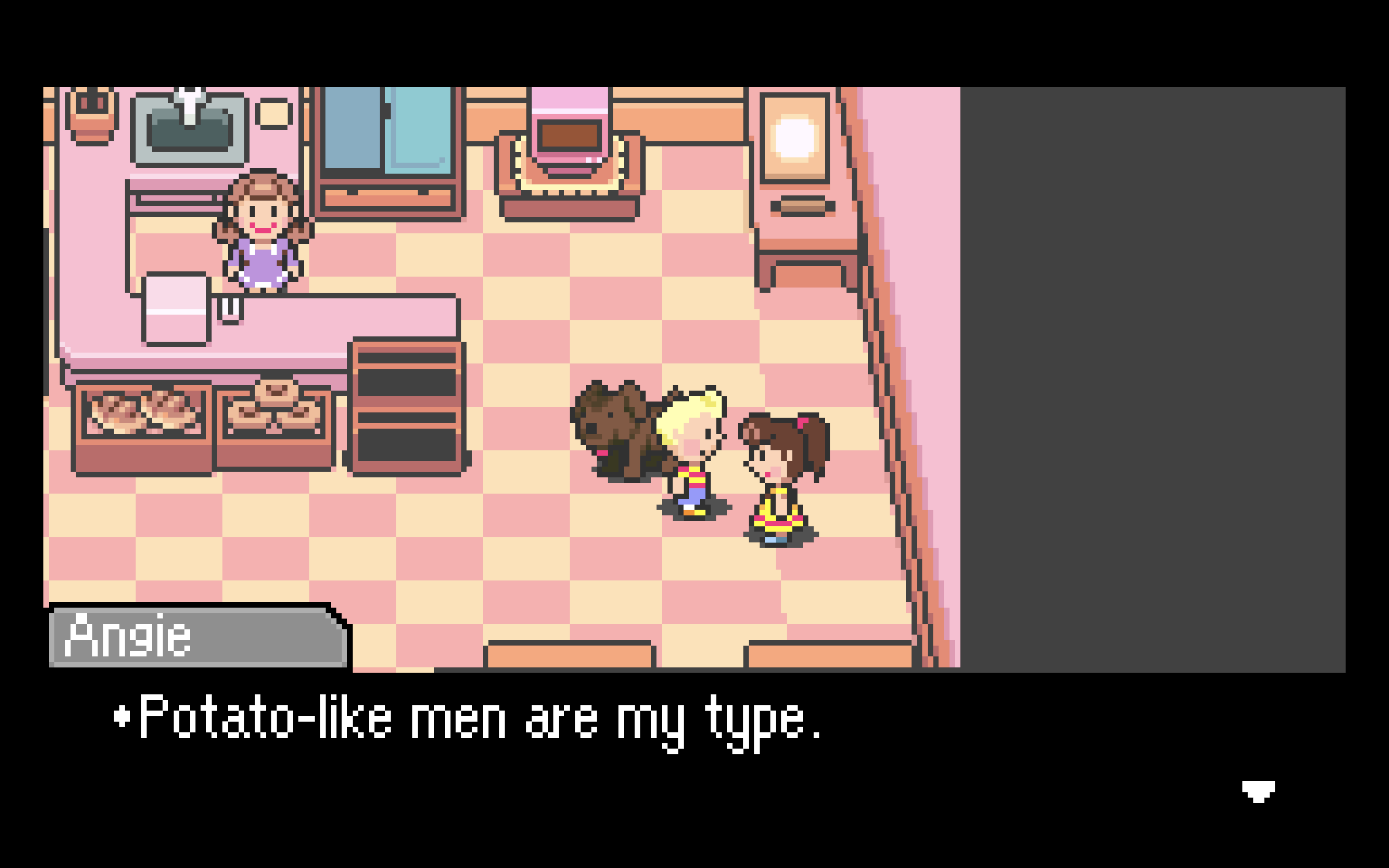
And of course, that’s to say little of the dozens of funny, weird, and somewhat off-putting characters that pepper the Nowhere Isles. Tazmily Village alone has what feels like dozens of characters with bespoke names and roles in the village, helping you build an attachment to the village in the early stages in the game - and making its inevitable transformation that much more heart-rending. Even random, no-name characters can throw you for a loop on how ridiculous they can be - entire mini-storylines can take place through them as you talk to them in each new chapter. Additionally, the Magypses are a unique inclusion in video games as a whole, being characters defined beyond gender, with clear LGBT traits and a whole otherworldly vibe. I do, to a point, think they do fall into some less-than-stellar tropes, the Magypses are fascinating, funny, and weird in the best way and they’re just something you don’t see in video games as a whole - ESPECIALLY Japanese games in the mid 2000s.
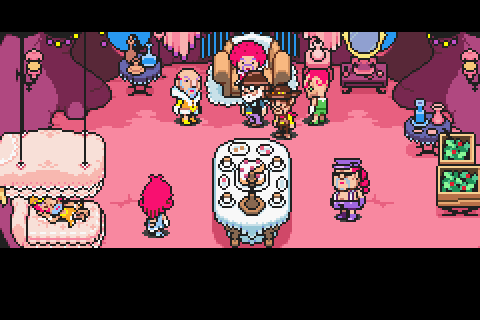
And whilst I have been talking about the story all this time, the devil is in the details. Easily the general highlight of the game is its overall approach to writing in the moment; everything has this offputting, eerie, frequently dark undercurrent, but Mother 3 never lets go of the humour, positivity and wackiness that’s inherent to the series. Even the most serious of, the darkest of moments - sans perhaps the ending - never quite suffer from tonal whiplash, as you’ll dance from dealing with an army of inept, fascist soldiers, to chatting with the race of Mr. Saturns, a species who defy any explanation. Seriously, I don’t know if I’ve ever seen a game maintain such a fine balance of tone and comedy while covering such dark subject matter. As an aside, I don’t think anyone who has completed Mother 3 will ever forget Tanetane Island as anything but one of the most unforgettable - and disturbing - experiences in an RPG. If you know, you know.
Rhythmic Progress
I’m surprised it took this long to actually get here, but we should probably talk about the bread-and-butter of any RPG - its battle system. And it's a DAMN good one. Mother 3’s battles are fairly similar to Earthbound’s, which in itself is just an iteration on the ‘first-person’ style of RPG battles defined by Dragon Quest. In that sense, Mother 3’s battles have two unique elements that set it apart from the chaff; like Earthbound, it features a ‘rolling’ health system. To explain, imagine that Lucas has 100HP, and he takes a hit that deals 100HP damage; he’ll be noted as taking a mortal blow, but the ‘ticker’ that displays his HP begins to rapidly count down from 100 to 0; Lucas can continue to fight until that ticker hits 0, so if you can get through turns fast enough, you can quickly using a healing spell or item to save him from death. At first, this feels like a fairly minor system, since early-game health pools are pretty small and thus will tick down almost instantly, but in later game fights you’ll have a lot more time to play with the system.
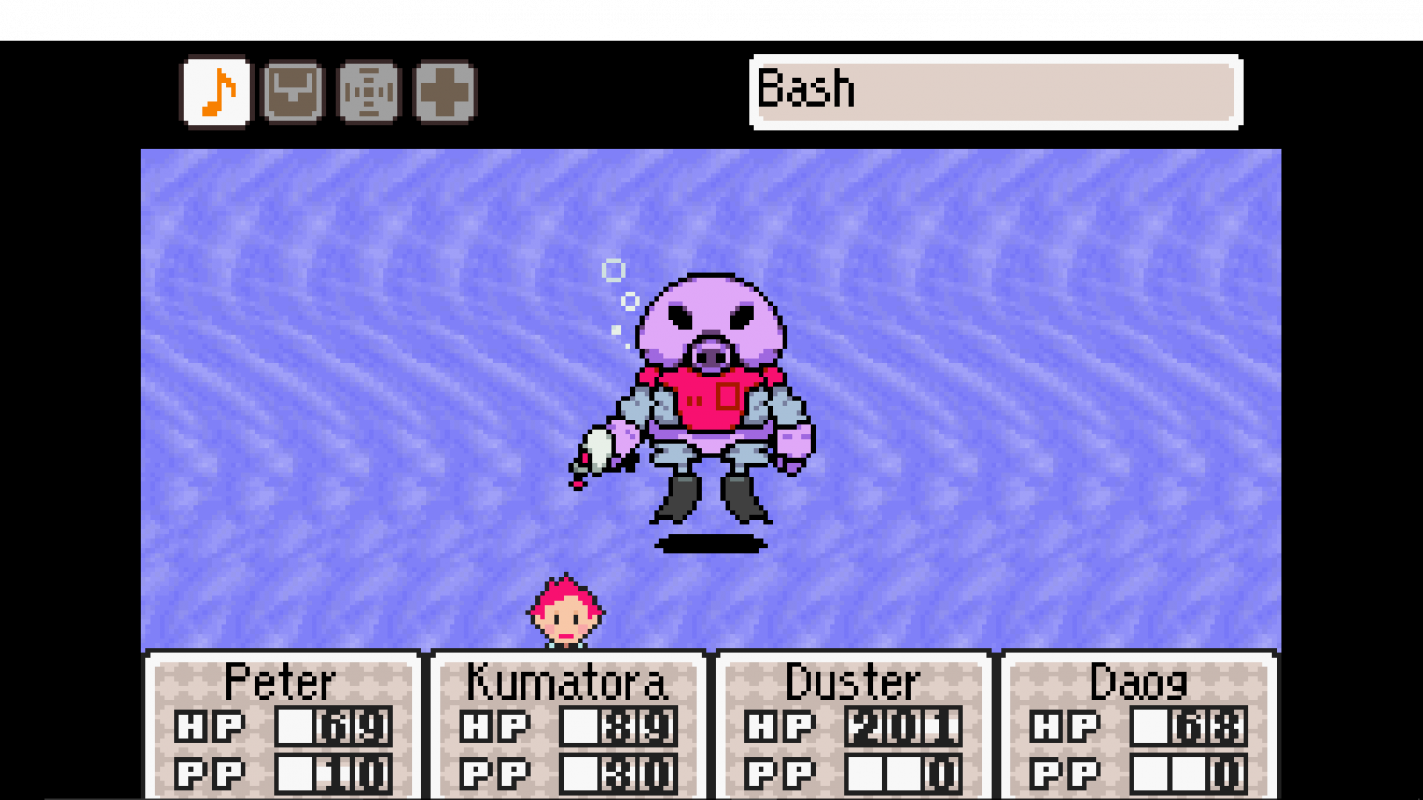
The other element that Mother 3 exclusively brings to the table is a minor rhythm game that takes place every time you use a basic attack. Y’see, rather than having a handful of battle themes you’ll be hearing ad infinitum, Mother 3 features a pretty diverse set of battle themes that correspond to a wide variety of enemies. Upon using a basic attack, if you continue to tap the A button at the same pace as a beat in the song, you’ll be able to continue doing small amounts of damage with each tap, with the possibility of chaining a sixteen hit combo. In all honesty, I’m pretty woeful at the system and unless you’re playing on proper hardware, it can be pretty hard to get a rhythm chain going, but it’s a system that rewards those with that finger-tapping bone in their body, and the game isn’t difficult enough to punish those who struggle to follow-up.
All this to say: I’m not a person who blasts the old-school, turn-based gameplay endemic to older RPGs Mother 3 emulates, but the longer a game stretches on, the more and more samey combat gets. It’s the opposite for Mother 3; the rhythm system, as finicky as it can be, constantly challenges you to be active in fights, and the further you get into the game, and the higher your HP values grow, the more you can play around the daring rolling HP system. Honestly? It’s probably the perfect ‘old-school’ era turn-based battle system; it caters to the simplicity of the system, but has enough bells and whistles to keep you engaged throughout. Plus, I just love that if you hold down the A button, it’ll instantly just have your character's basic attack, which makes the odd bit of grinding or easy enemies a piece of cake.
The Game Boy Advance's Limits
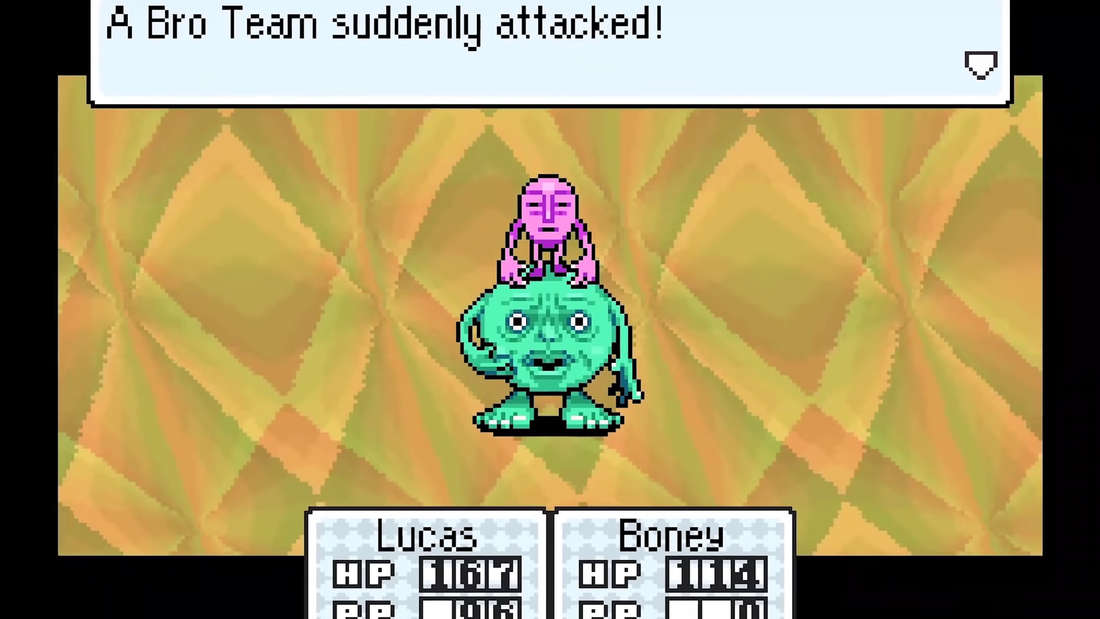
It also helps that pretty much every enemy design is a winner; outside of Pig Mask Soldiers, the vast majority of enemies in these games are animals or robotic chimeras - or animal-robotic chimeras. They’ll look nice and cute when you see them on the overworld - yes, if you’re fast enough, you can avoid encounters altogether - but when they pop into the battle screen… Well, some of them are cute. Some of them are bloody horrifying. Or hilarious. Or… mildly disturbing. Maybe more than mildly disturbing. Creature design runs the gauntlet of everything you can imagine, turning even the most benign of fights into chucklefests or horror shows.
This visual diversity goes double for the world of the Nowhere Isles. The lands Lucas and his friends wander are lush, harmonious and charming… until they aren’t, replaced by the cold steel and single-minded, capitalistic results of the Pig Mask Army’s efforts. One of the last areas in the game is a gigantic city that just feels… wrong. Really, really wrong. Mother 3 is easily the apex of this ‘era’ of pixel RPGs - incredibly clean and detailed, an improvement on anything the GBA and earlier had presented. Exploring Mother 3’s world is fairly linear, as a lot of the areas you visit are one-and-done experiences - basically, Mother 3’s version of dungeons. But the visual variety is always there, always tinged with a sense of weirdness and wrongness that is Mother 3’s trademark. And as disconcerting as it’s meant to be, I really like the way the game blends nature and human construct together in its locales - blended frequently into insanity, but blended nonetheless. Again, when you get to TaneTane island, you’ll know. Mother 3 is BOLD.
This extends to the game’s soundtrack as well; as much as I love the console, the GBA’s sound chip isn’t the best and it can lead to a lot of fuzzy, and genuinely awful sounding soundtracks. Mother 3 is, obviously, not one of those games. With Mother 3 coming out at the very tail end of the GBA’s release library, it feels like the mastery of the console’s capabilities had been wrangled. The music’s ability to alter your mood - the unease built by the distant PigMask theme, the silliness inherent to the Club Attic Dungeon, or the way my heart breaks whenever I hear Hinawa’s Theme of Love. Even if this wasn’t the best game on the GBA, it’s by far the best soundtrack. It’s also insane how much music there is - six hours of it!
Even if Mother 3 isn’t one of - if not the single - most personal game I’ve ever played, I don’t think it’s too much to describe the game as a masterpiece. A game that tackles some extremely adult, intelligent and deeply dark themes thoughtfully, it’s also just a damn good RPG with some amazing bells and whistles to iterate over Earthbound’s battle system. Its cast are some of the most lovable in all of gaming, its humour is wacky, unexpected and heartfelt, and it all culminates in one of the greatest final stretches to a game I’ve ever seen - and perhaps the most beautiful, hopeful ending, too. This review has been ranty, overlong and frankly, ridiculous. Honestly, it feels more like a video script at times. But I don’t care; Mother 3 is one of the best games of all time, and if there has been a single game of the hundred I’ve reviewed thus far that I’ve convinced you to play, let it be this one. Mother 3 is a masterpiece, and there’s nothing else to be said on the matter. It’s simply a masterpiece.
Thank you so much for reading the Game Boy Abyss all these years. A hundred reviews, huh? It was always my base goal, but I honestly didn’t know if I’d make it this far. It was always just going to be a fun little project, but the fact that so many people read my reviews, send me such lovely emails and comments, it really is what keeps me going (along with my love of this weird little console). But we’re not done! We’ll never be done, I don’t think. Again, thanks for everything. As always, you can find me on BlueSky under GameBoyAbyss, or email me at mgeorge7003@hotmail.com if you have any questions, comments, or suggestions. Thank you again for reading, and I’ll see you next review!