
The Bible Game - Sunday School, At Home!
20/04/26

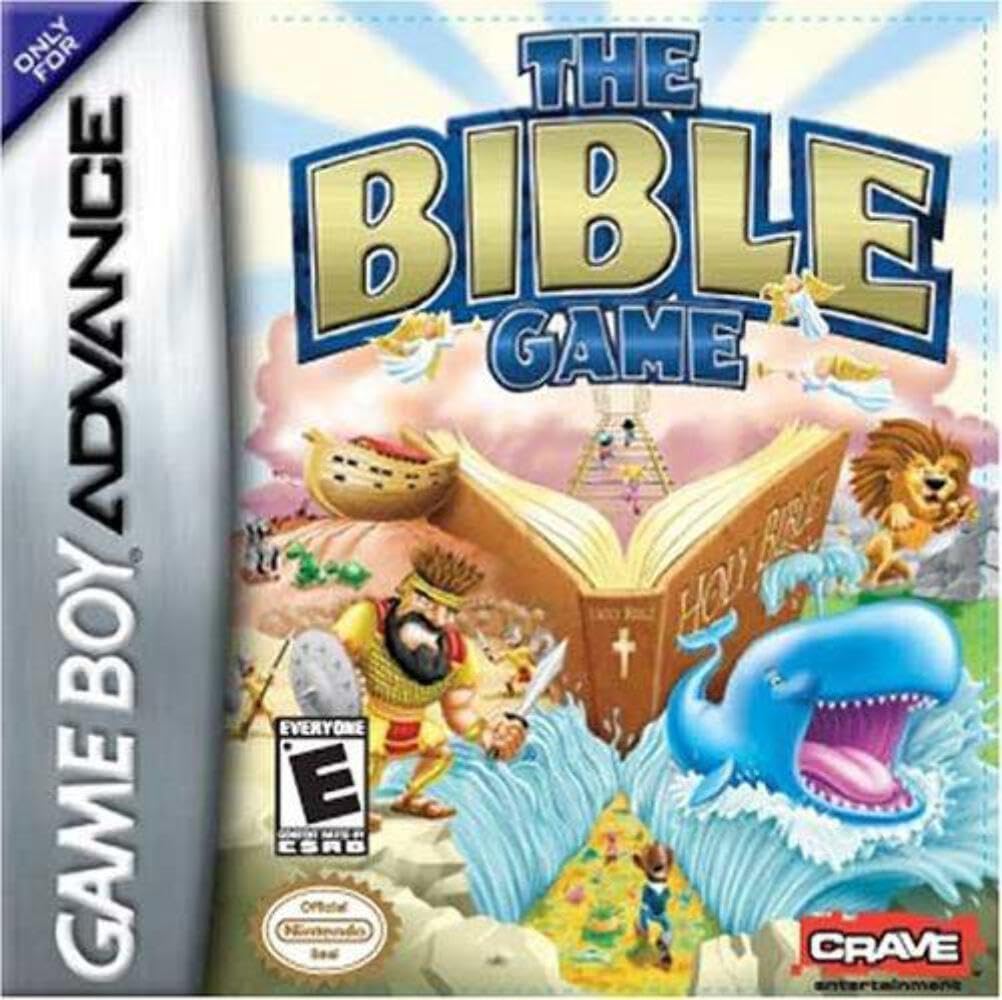
The Bible. One of the oldest written works in the world, the cornerstone of a faith, and, unsurprisingly, a frequent source of inspiration for a vast variety of media. Children’s television, such as the genuinely fantastic Veggietales, a wide variety of films, both good (Ten Commandments is genuinely really good) and bad (pretty much any biblical Christmas movie) and of course, no small number of video games. But, I feel anyone with even a passing knowledge on the history of video games knows that the ratio of good to bad bible-based video games is weighted towards one end very, very heavily - and the Bible Game does nothing to push it in the other direction.
Growing up in a Christian household, particularly my grandmothers, several of the video games I had access to were essentially game-fied retellings of various bible stories that were more-or-less minigame collections. Helping build Noah’s Ark, or a cartoonish version of the tale of the Prodigal Son. As a kid, I dug them, half because I didn’t have much else to play, but also, they were okay, albeit basic, kids games. If I played them today? Probably straight up garbage. But not all Christian video games are inherently bad; heck, we’ve covered a pretty decent one on this very website, in the form of the sole Larry-Boy game. But, sadly, the Game Boy Advance isn’t a unique haven for the spiritual video game; The Bible Game, despite some interesting ideas, instantly, stretching its initially interesting, unique format beyond any kind of warm welcome it initially instills.
Tales From The Bible
The Bible Game’s structure is very stringent in format; across a half dozen stages, you’ll wander various locales that represent - accurately or not is another question - the ‘Bible Kingdoms’; i.e, generic township/desert/forest and so on. Playing as a child enraptured with bible stories, I think you’re kind of… mentally roleplaying or something, seeking out the pieces of the Armor of God. The Armor of God is the belief in God that’ll protect you from deceivers and tricksters, but to the creative, gentle minds of these children, they see it as a physical suit of armor. Regardless of the rest of the game, I think this set-up is adorable, and a really nice way to tell the metaphor of the Armor of God to the very wide-eyed kids this game is made for.
-260420-111812.png)
I just can’t imagine that same wide-eyed audience remaining engaged with, y’know, the ACUTAL game.
Wandering within each location, you’ll encounter demon-like Tricksters, who’ll be fluttering about causing mischief and trying to blast you with fireball, but if you manage to blast them first with some good ‘ol holy water, you’ll get a chance to strike them with your Bible and defeat them the only way you could imagine - that’s right! Bible Trivia! Answer enough questions from the set each trickster provides, and you’ll earn the piece of a key needed to enter a church, where a piece of the Armor of God lies, which will then unlock the next stage of the game. Basic, yes, but I didn’t grow to dislike the game’s format straight away.
Which was challenging, as from the jump, it’s not hard to tell that The Bible Game is not particularly well made. This is most emblematic before you even start playing, with a cutscene with visuals so offputting and outright horrific I place money on it terrifying the very young playerbase it was aiming for. This is instantly followed by the game’s form of a tutorial - pages upon pages on blank backgrounds, explaining exactly how everything in the game works, all written in a way that’s instantly forgettable and required me to constantly refer back to it when I got stuck. This game is cheap, don’t be misled, but if a game needs as many tutorials as The Bible Game apparently needs, make them part of the damn game!
In any case, across each zone, you’ll encounter the here-ticks (quite possibly the greatest pun I’ve seen in any GBA game), who are easily dispatched with a jump and good ‘ol squish. Upon defeating any of them, they’ll either drop a cross, which can be traded with NPCs for holy water, which I mentioned makes the Tricksters vulnerable to, uh, quizzing, or a scroll, which will contain a piece of Bible trivia and will be an answer to one of the questions in that particular level. As I said, taking its premise in a vacuum, I don’t loathe the Bible Game. I like the almost little diorama settings of each level, the nearly diegetic setting of a child's imagination of ‘the Bible Kingdoms’. It's just a shame that the game’s already shaky foundation crumbles totally when you get to the game’s central point - the bible quizzes to defeat the Tricksters.
-260420-111941.png)
Have you ever Quizzed with the Devil in the Pale Moonlight?
Now, obviously this being a game about the Bible, a big part of the game is educating its players about the titular book. It’s education disguised as entertainment, nothing more, but all the more power to them for making a GBA game the delivery method. The big issue with using the game’s knowledge quiz as the central mechanic of the entire experience is more a matter of numbers than anything else.
The question is thus: For my likely largely non-Christian readerbase, how are you meant to know the answers to these biblical quizzes? I know I already mentioned the ability to find scrolls from the here-ticks, but bear with me as I describe this innate issue with the game.
-260420-111914.png)
At first, you'll only have to answer a handful of questions out of the total provided by correctly to ‘defeat’ the first couple tricksters, but this number balloons as the game progresses, requiring more and more answers of any given total set of questions to win. And, as far as I can tell, the vast majority of the Tricksters provide unique questions, so by game’s end, you’ll need to have known - or more likely, looked up - the answers to hundreds - if not over a thousand - of bible-related questions. I think this problem was meant to have one of three solutions:
Well, maybe you’re just meant to use the mechanic I already described - jump on the here-ticks, get the scrolls. Easy! Well, if the devs intended that, they’re insane. Due to the fact that scrolls are single-use, and unable to be recalled during the quiz sections, the devs would expect their likely-young playerbase to be writing down over a thousand answers, which is just… insanity.
The player had a bible on hand to research the answers themselves - you’ve got no time limit on answering within the quiz sections, so you’d have plenty of time to page through verses to find your answer. A little more likely, but still, kind of insane.
Or, finally, they had an expectation that their players would be of a more studious nature, and would already have the answers within them - again, also insane, because of the sheer amount of questions on offer.
-260420-111859.png)
I’m probably overthinking a game about the bible from 20 years ago - yes, this was in the final years of the Game Boy Advance’s lifespan, take that as you will - but having such a gigantic swath of questions kind of makes this a game for no one. If you already know the answers, you’re not going to get anything out of it. If you’re willing to struggle to find the answers, via looking them up or using an absurd amount of scrolls to find them, you’re 100% going to get bored, or burn out, within an hour, and would be better off just actually reading the Bible.
Searching For Meaning
But I think the worst thing about the quizzes is the fact that I don’t think someone is ever going to really learn anything from this game. It’s just a game of trivia, more than anything. I’m sure you’ll glean the odd bit of knowledge here and there, but the Bible is a story of morality, of lessons on human nature and their connection to God. None of that really comes through in the Bible Game - most of the questions are just ‘who was the father of ___’ or, ‘Who was Jesus referring to in this passage’-type questions. It feels like the school system, challenging you to memorise, rather than learn, and no matter how I feel about The Bible Game, or Christiantiy as a whole… If you want your game to reach people, tell the stories that make The Bible so meaningful, not these cookie-cutter questions and answers that make up this game’s bloated runtime.
But despite everything I just said, as someone who only really remembers the larger, more culturally relevant sections of the Bible, I actually had a decent time for a bit with the quizzes. I was on a call with friends, sharing my screen, and we were having great fun trying to work out the answers ourselves, trying to tease out little nuggets of wisdom from childhood hidden away in our brains. We were frequently very, very wrong, but it was still fun enough. For the first two levels, I didn’t hate my time with the Bible Game. Maybe, just maybe, I can just push past the quizzes with the help of my friends, and enjoy the rest of the game?
-260420-111828.png)
Sadly, that wasn’t to be. The Bible Game, despite piquing my interest at first from its unique look and structure, doesn’t really do anything to innovate over its runtime. The fun I had with friends quickly waned as we realised nothing would really change across its playtime. You’ll just be doing the same things, over and over again, with each level longer than the last. More tricksters, more questions to memorize, all in slightly different looking, slightly larger areas, And knowing this, I dropped the game after only an hour and a half of playtime. My time has to be worth something, y’know.
An Unearthly Experience
Now, I’d 100% be remiss to describe The Bible Game as looking ‘good’. In fact, the game pretty much announces the low quality of its visuals in its opening cutscene, featuring some of the most unearthly, frankly horrifying people I’ve ever seen on the console. But something about the stages you wander, it drew me in like something from my childhood, a dream I never had. Maybe it’s the isometric format, the way the stages are laid or the designs of the buildings, but there’s something so… I can’t even put it into words. But I digress - this game came out in late 2005, the tail end of the Game Boy Advance, when the very best looking games on the system were debuting; no matter how evocative the visual design of the The Bible Game is for me, the fact that it’s details, from it’s weird ass humans, to the bizarre Tricksters, to the blur that covers everything like a paste… the fact that the game looks so poor, like an old, even early 90s PC game is inexcusable.
-260420-111752.png)
On the other hand, as crazy as it sounds, The Bible Game might have some of the best voice acting I’ve heard on the Game Boy Advance. Voice acting on this system is incredibly, incredibly rare, due to the already rough quality of the sound chip. But the fact that there’s a decent amount of voice work, that it’s generally pretty legible (regardless of the actual quality of the voice work itself) deserves praise in itself. Genuinely impressed in this regard, and it’s even more impressive considering any incidental music in the game is so sparse and forgettable, I genuinely forgot it was even in the game at all.
If anything, The Bible Game deserves props for trying to deliver its message and edutainment in a fairly unique fashion. Whilst it’s clear from the outset that this isn’t a good game, the inherent weirdness and unique structure kept me entertained for a good hour or so. But when you realise that it never wavers from that structure, that it just stretches itself more and more for no real gain, coupled with the fact it plays like jank despite coming out in the last year of big GBA releases… It’s an interesting game, to be sure, a strange little footnote in the GBA’s history, but there’s nothing here for anyone - just trivia that those devout enough to care would already know, and those who wish to learn? There’s so many more places than the thrice-damned Bible Game.